
In the study of mutualism, some of the most interesting stories come from relationships that are not as simple as they first appear. A mutualism is a relationship between two species in which both sides gain a net benefit. Even so, those pairings do not always exist alone. Other species can enter the picture and change the balance.
That is what makes one ant-acacia system such a useful case in examples of mutualism. In this system, ants and acacia trees are the main partners. The ants protect the trees and the trees support the ants. But orb-weaver spiders also live on the acacias, and their role is not easy to define.
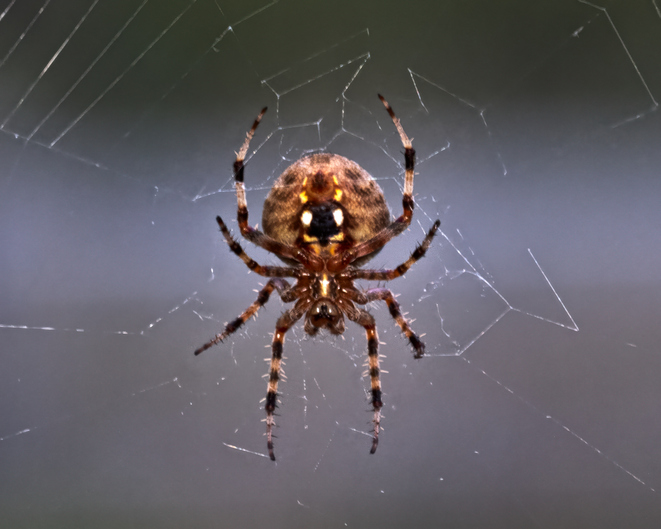
The spiders in this study were two Eustala species — Eustala oblonga and Eustala illicita. These orb-weaver spiders live on the ant-defended acacias and build webs among the branches at night. During the day, they stay still on leaves, stems, and thorns while ants patrol the plant.
These spiders do not seem to attack the patrolling ants. Instead, they appear to take advantage of the ant’s aggression which makes the tree a safer place to live. In other words, they exploit the system for protection.
This adds a third species to a two-species partnership and makes the system much more complex. The spiders may get protection from their own enemies, but the larger question is whether they help the ant-acacia partnership, harm it, or do both at the same time.
What mutualism means in this system
At its core, mutualism is about how species exchange benefits. In this case, the plant and the ants form the main mutualism. The acacia offers the ants a place to live and access to specialized food resources. In return, the ants defend the tree, patrolling it aggressively and stinging or driving off animals that could damage it.
The spiders are different. They are not one of the main partners in the exchange, but a third-party species living inside that protected space. The study describes them as exploiters because they take advantage of the ants’ defense without clearly offering a direct service in return.
The spiders gain what ecologists call an “enemy-free space.” This means they are living in a place where their own risk from predators is lower. The ants make the acacia a difficult place for many enemies to hunt, which may help the spiders survive.
Still, exploitation does not always mean the exploiter has no effect on the system. Sometimes a third species can create both costs and benefits at the same time.
Why the spiders might help
One possible benefit the spiders offer is catching plant-eating insects that threaten the health of the tree.
The study found that herbivorous insects were common around the acacia foliage. Sticky card traps showed large numbers of insects such as leafhoppers, beetles, and other plant-feeding groups moving through the trees. This supports the idea that spiders could protect acacias by trapping herbivores in their webs.
An extra layer of defense may matter in this system. If ants protect the plant in one way and spiders protect it in another, the plant may gain from both.
Some specialist herbivores have ways to avoid patrolling ants. In theory, spiders might help where ants cannot. A web can catch insects that slip past the ant defense, intercepting flying herbivores before those insects settle, feed, or lay eggs.
This makes the spiders possible allies of the plant, at least under some conditions — a good reminder that a species does not need to be part of the original exchange to affect the outcome.
Why the spiders might cause harm
However, the spiders do not catch only herbivores, but alate ants as well. Alates are the winged reproductive ants, including males and queens, that leave the colony during nuptial flights to mate and start new colonies.
If the spiders capture too many alates, they may reduce the number of successful new ant colonies, potentially weakening the long-term success of the mutualism. The same spider that may help the tree by catching herbivores may also hurt the ants and the acacias by preventing the next generation.
That tension sits at the center of this particular example of mutualism. The spiders are not easy to place on one side. Their effect depends on what they catch, how often they catch it, and what those losses mean for the larger system.
What the study found
The study compared two things: which insects were available around the acacias and what the spiders actually captured in their webs.
The sticky card traps suggested that herbivores were the most abundant group moving through the foliage. Beetles and hoppers were especially common. This data supports the idea that herbivores were a major part of the insect traffic around the plants.
But the remains of prey found in spider webs told a different story. Hymenopterans made up most of the identified remains. Most of those were ant alates, including alates from the ant species involved in the mutualism. Even though herbivores were common in the environment, they were not the majority of what the spiders had actually eaten.
Differences between the species
The two spider species did not behave in exactly the same way.
Eustala illicita captured mutualist ant alates at a higher rate. In that species, alates of Pseudomyrmex spinicola made up half of the prey remains. Herbivores were present too, but in smaller amounts.
Eustala oblonga also captured mutualist ant alates, but at a lower rate. In that spider’s webs, alates of Pseudomyrmex satanicus made up less than one quarter of the prey remains. Herbivores and predator or parasitoid insects made up somewhat larger shares there.
The two spider species were also tied to different acacia hosts, and that likely shaped what they encountered in the field. Eustala illicita was found on Vachellia collinsii, while Eustala oblonga was found on Vachellia melanocerus. These plant species differed in how densely they grew, which may have affected how often ant alates moved through spider webs during mating periods.
In denser stands of acacias, reproductive ants may be more likely to pass through nearby branches and web sites, increasing the chance of capture. In more widely spaced plants, that risk may be lower.
This difference matters because it shows that the spiders’ role is not the same across all cases. Even within one type of mutualism, the outcome can shift depending on which spider, which ant, and which acacia species are involved.
Why context matters so much
The study suggests that ecological context may explain some of these differences.
One factor is plant density. One acacia species occurred at lower density, while the other was found in much tighter groups. When more acacias are close together, ant alates may move through a denser web-filled space, which could raise the probability of spiders catching them.
Another factor is ant mating behavior. The two ant species differ in how alates move during mating. In one case, males may both leave and fly toward host acacias to find dispersing queens, which may raise the chance of capture. In the other case, males and females disperse away to mate elsewhere, which may lower activity around webs.
These details help explain why one spider species caught more mutualist alates than the other. The difference may not come from the spiders alone. It may come from the whole ecological setting around them.
This is an important concept in the study of mutualism. Relationships in nature are shaped not only by species identity, but also by behavior, location, timing, and density.
The role of season
Season also appears to be a factor.
The main interpretation of the study comes from wet-season data, when spider numbers were much higher. In the dry season, spider density dropped sharply.
This suggests that any effect the spiders have may be strongly seasonal. If there are many fewer spiders and fewer active webs in the dry season, then their impact on herbivores or ant alates may be much smaller during that part of the year.
One species can look highly important in one season and much less important in another. In mutualism biology, timing can shape the real effect of a third-party species just as much as diet does.
Are the spiders friends or foes?
The clearest answer is that they may be both, and the overall effect is probably small or uncertain.
The spiders seem to exploit the ant-acacia mutualism for enemy-free space. They benefit from living on a plant defended by aggressive ants. At the same time, they may provide some value to the plant by catching herbivorous insects. But they may also create a cost by capturing reproductive ants during nuptial flights.
Ants already provide strong plant defense, so extra help from spiders may not change much. On the other hand, if only a small fraction of reproductive ants are caught, then the harm to ant colony founding may also be limited.
The most careful conclusion is that the spiders probably do not strongly shift the mutualism in one clear direction. Their impact seems to depend on context, including which species are involved, how densely the plants grow, how the ants mate, and what season it is.
What this case adds to our understanding of mutualism
This study provides novel insight into biological mutualisms because it shows how messy real biological relationships can be. Nature does not always divide neatly into helpers and harmers.
A third-party species can take benefits from a partnership while also creating new effects inside it. In this case, orb-weaver spiders appear to gain safety from the ants, possibly help the tree by catching herbivores, and possibly harm the ants by catching alates. None of those roles cancels the others completely. They exist together.